


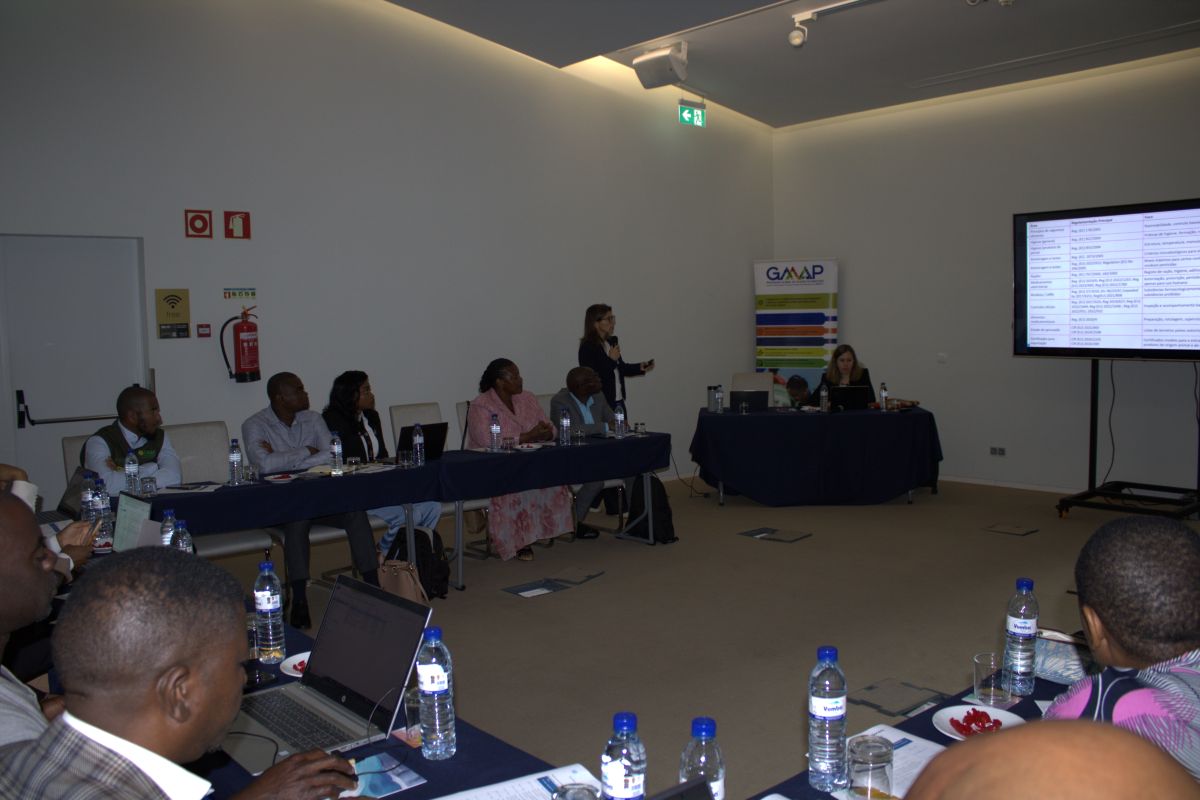
Access to the European Union market is an important opportunity for countries seeking to add value to fishery, aquaculture and other animal-origin products. But it is also a demanding, technical and evidence-based process. Part 1 of this training addressed the foundations of European legislation and official controls.
The session explained that the European Union operates with common rules to ensure that food placed on the market is safe, hygienic, traceable and produced under appropriate control. For third countries such as Mozambique, the challenge is to demonstrate equivalence: proving that the national system provides guarantees comparable to those required within the European Union.
Key regulations were presented, including general food-safety principles, the hygiene package, requirements for animal-origin products and the official-controls regulation. The training also highlighted the importance of tools such as EUR-Lex, where technicians can consult legislation in force, consolidated texts and legal amendments.
A central point was the distinction between responsibilities. The economic operator is responsible for placing safe products on the market. The competent authority must ensure that effective official controls are in place, based on risk analysis, with capacity to license, inspect, monitor, apply corrective measures and certify products for export.
The session also introduced lists of authorised third countries, the importance of approved establishments and DG SANTE audit reports. These documents help countries understand what is assessed and what type of evidence must be available.
The key message is that access to the European market does not begin at the moment of export. It begins years earlier, with updated legislation, capable institutions, controlled operators, credible laboratories, traceability and a culture of compliance.
Watch the full Part 1/3 video
Traceability, RASFF and sanitary certification
Part 2 of the training explored critical issues for access to the European market: residues, antimicrobials, veterinary medicines, traceability, RASFF, sanitary certification and documentary evidence.
The session began by reinforcing an important distinction: antimicrobials are not only antibiotics. Antibiotics are one class within a wider group of antimicrobial substances. This distinction matters because European legislation has strengthened controls over the use of these products in food-producing animals.
The training explained typical audit questions: is national legislation in force? Is the annual control plan documented? Are sampling procedures clear? Are measures defined for non-compliant results? Are standard operating procedures available? How is documentation managed? What evidence links national legislation to European requirements?
The session also presented RASFF, the European rapid alert system for food and feed. This public tool allows users to search notifications by country, product, risk and type of non-compliance. Examples showed how notifications related to mercury, parasites, sanitary certificates and cold-chain failures can lead to intensified controls based on risk analysis.
Another central topic was the control of veterinary medicines: market authorisation, import, distribution, prescription, use, records, withdrawal periods and prohibited substances. For products exported to the European Union, sanitary certificates now require clear declarations on compliance with rules on antimicrobial use.
The main lesson is that good intentions are not enough. Legislation, procedures, records, traceability and the ability to demonstrate that the system works are all required.
Watch the full Part 2/3
Sampling and compliance: keeping the path open to the European market – Part 3/3
Part 3 of the training closed the technical series on access to the European market with a practical discussion on sampling, non-compliant results, DG SANTE questionnaires, legal updates, institutional communication and challenges for Mozambique.
The session highlighted that sampling should combine different strategies: random sampling, targeting higher-risk operators, focusing on priority substances and using historical data, analytical trends, alerts and RASFF results. This makes official controls more effective and proportionate to risk.
When a laboratory result is non-compliant, the competent authority must act quickly and methodically. It may be necessary to block lots, investigate the origin, trace the chain, communicate with operators, inform destination markets and demonstrate that the system can respond. The way a country manages a non-compliance is part of the evidence that its official system is reliable.
The training also explained the DG SANTE questionnaire for residue and contaminant control plans. The questionnaire requires information on responsible authorities, previous-year results, laboratory networks, parameters, matrices, ISO 17025 accreditation, pharmacological substances, system independence and anti-corruption measures.
The final discussion reinforced a key idea: the private sector, competent authorities, laboratories and public institutions need to communicate better. Food safety starts in the domestic market, but the same quality foundation also opens doors to international markets.
Watch the full Part 3/3 video