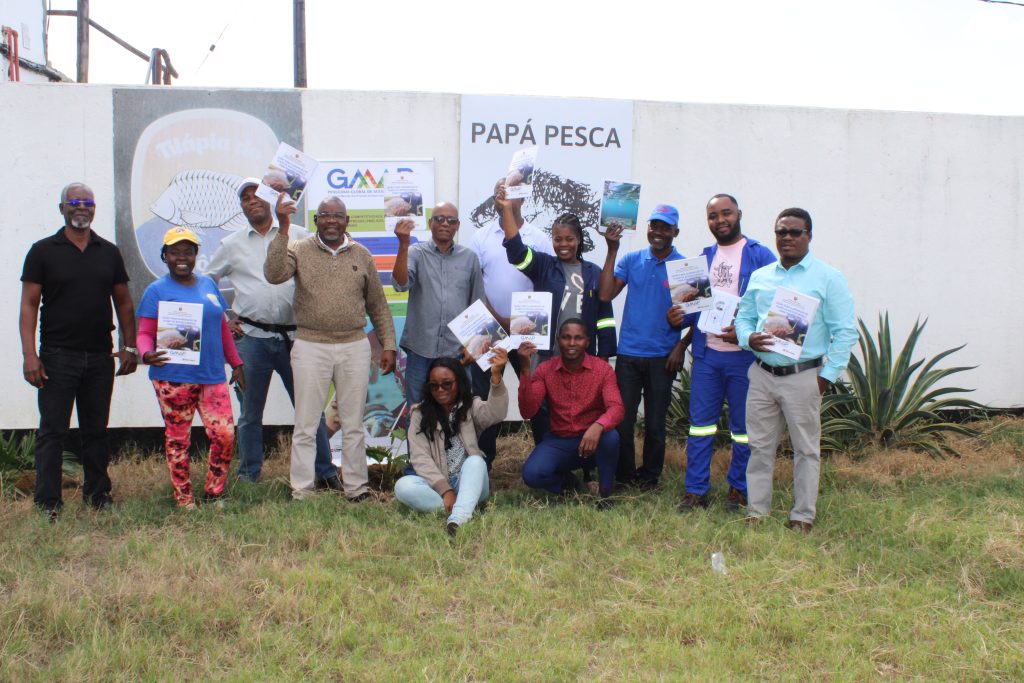
Chokwé, May 14, 2025 – Following a remarkable session in Moamba, the training on biosecurity in aquaculture promoted by the MAMAP Project, implemented by UNIDO with funding from NORAD, arrived in Gaza province, bringing together fish farmers and technicians at the Papá Pesca unit in the district of Chokwé.
The initiative, which is part of a regional training cycle, aims to provide aquaculture operators with practical knowledge on how to prevent disease outbreaks, protect nurseries, and ensure the productivity of their production systems.
Challenges in the field are voiced
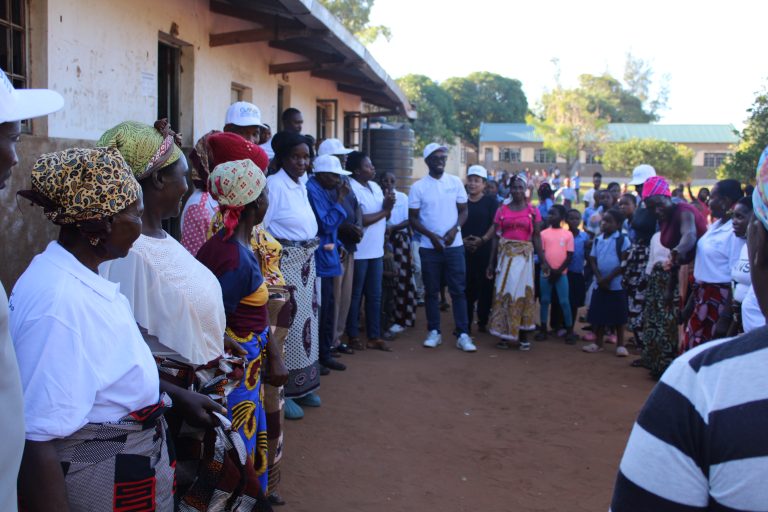
The session began with a frank discussion with local fish farmers. Among the main challenges identified were feed shortages, predators in the tanks, soil infiltration and capillarity problems, and unstable access to the market for selling their production.
“If, with all these problems, we also have to deal with disease, it will be difficult to start over. We are here because we still have time to prevent it,” warned one of the participants during the exchange of experiences.
Papá Pesca: a local example of biosecurity
During the technical visit to the Papá Pesca unit, participants were able to observe in loco a structured model of fry production with good sanitary practices. The production area has 57 tanks, divided between breeders, reversion, and fattening.
The process begins with mating in earthen tanks, followed by the collection and rigorous selection of eggs.
“We take the trays with us to differentiate the eggs. The unfertilized ones, like the white ones, are immediately discarded,” explained one of the unit’s technicians.
The environment already has visible biosecurity measures in place, from access control to separation by functional areas. The idea, according to the organizers, is that the practices observed can be replicated in other smaller-scale units.

Practical training with real impact
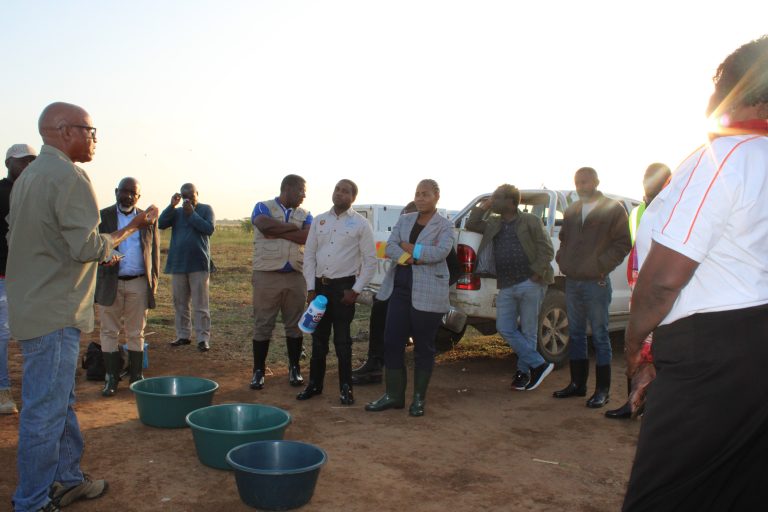
As in Moamba, the training in Gaza included an intensive practical session, where fish farmers learned how to apply disinfectant solutions, set up footbaths, calculate chlorine dosages, and discuss ways to improve circulation control and hygiene in their facilities.
Each participant received a copy of the Fish Farming Biosecurity Manual, developed by INIP with technical support from UNIDO, as a tool to continue applying what they learned in their daily work.
“Our goal is for each fish farmer to leave here with a simple but effective plan to protect their production. Biosecurity starts with small gestures,” emphasized Vicente Ernesto, training consultant.

The journey continues through Inhambane
The next stop for the training caravan is the province of Inhambane, with sessions scheduled for May 15 and 16 in Zavala (Sihaka) and Maxixe (Block 6), respectively.
With these training sessions, the MAMAP Project reinforces its commitment to promoting resilient, inclusive, and safe aquaculture—where every producer has the tools they need to face the challenges of the sector and continue to feed the country with dignity and quality.

Comments and conversation